After autumn arrives, I often like to keep one or two pomegranates on my worktable.
When you open the rough outer skin, the inside is filled with bright, crowded, translucent seeds — one resting against another, filling the whole fruit with a kind of quiet abundance.
Sometimes I only need to look at them for a while, and my heart begins to settle. There is something about a pomegranate that feels full, solid, and reassuring.
I used to think the meaning of pomegranates was a little old-fashioned. In Chinese culture, they are often connected with the blessing of many children and a flourishing family. For a long time, I thought that was all there was to it.
But after I began working with crystals, learning about garnet, and reading a little more about old stories from both East and West, I slowly understood something else.
People do not love the pomegranate simply because it has ?many? seeds.
We love the feeling it carries: an ordinary outside, and a deeply full inside. A kind of inner abundance that does not need to be loud.
The Kind of Abundance Both East and West Understand
It is interesting how cultures far apart from one another have often read the pomegranate in surprisingly similar ways.
In Chinese tradition, the pomegranate has long been a symbol of family, fertility, prosperity, and a life that continues to grow. In weddings, home blessings, and seasonal images, it often appears as a sign of fullness and good fortune.
But beneath that symbol, I feel there is something even more basic: the wish to feel secure.
Enough food stored away. Loved ones close. A home with life in it. A future that feels like it has roots.
This is not a flashy kind of richness. It is the quiet comfort of knowing that life is being filled from the inside.
In ancient Greek stories, the pomegranate was also connected with fertility, the earth, the turning of the seasons, and the cycle of life. It appears in myths of harvest, descent, return, and renewal.
The message feels simple and deep at the same time: when something has roots, it can pass through winter and still return to fruitfulness.
In both Eastern and Western imagination, the pomegranate is not only a lucky fruit. It is a very human image of steadiness.
To root inward. To gather slowly. To become full from within. To know that there is something solid beneath you.
From Pomegranate to Garnet
When I first learned where the name garnet came from, I found it beautiful in a very simple way.
Garnet was named because its small, deep red crystals reminded people of pomegranate seeds — rich in color, rounded in feeling, and gathered like little pieces of fruit.
But after working with garnet for a while, I began to feel that the connection goes beyond appearance.
There is something in the mood of garnet that also feels close to the pomegranate: warm, steady, rooted, and quietly full.
In crystal traditions, garnet is often seen as a stone of grounding, vitality, passion, devotion, and inner strength. It is also commonly connected with the root chakra — the place of safety, stability, and feeling at home in your own body.
This may sound mystical at first, but the feeling is not hard to understand.
Imagine opening a heavy pomegranate and seeing that it is full inside, not empty. Garnet gives me a similar impression. It does not feel like a sudden burst of excitement. It feels more like a warm hand under the heart, reminding you not to drift too far away from yourself.
So much of modern anxiety, at least for me, comes from a feeling of emptiness.
We keep moving forward, but sometimes without feeling rooted. We may already have many things, but still worry that everything could disappear. During the day, we answer the world. At night, when things become quiet, the heart can feel strangely hollow.
Garnet feels like a small reminder for that kind of moment.
You do not need to keep reaching outward to fill yourself. You may already be more full than you think.
Like a pomegranate, you do not need to show everything on the outside. Real steadiness is often quiet. It is the knowledge that there are seeds inside you, work in your hands, and a path beneath your feet.
A Small Anchor You Can Carry
People sometimes ask whether wearing garnet ?really works.?
I do not think of it as something dramatic or magical in a simple way. It will not finish your work for you, solve every worry, or make difficult days disappear.
But it can become a small anchor.
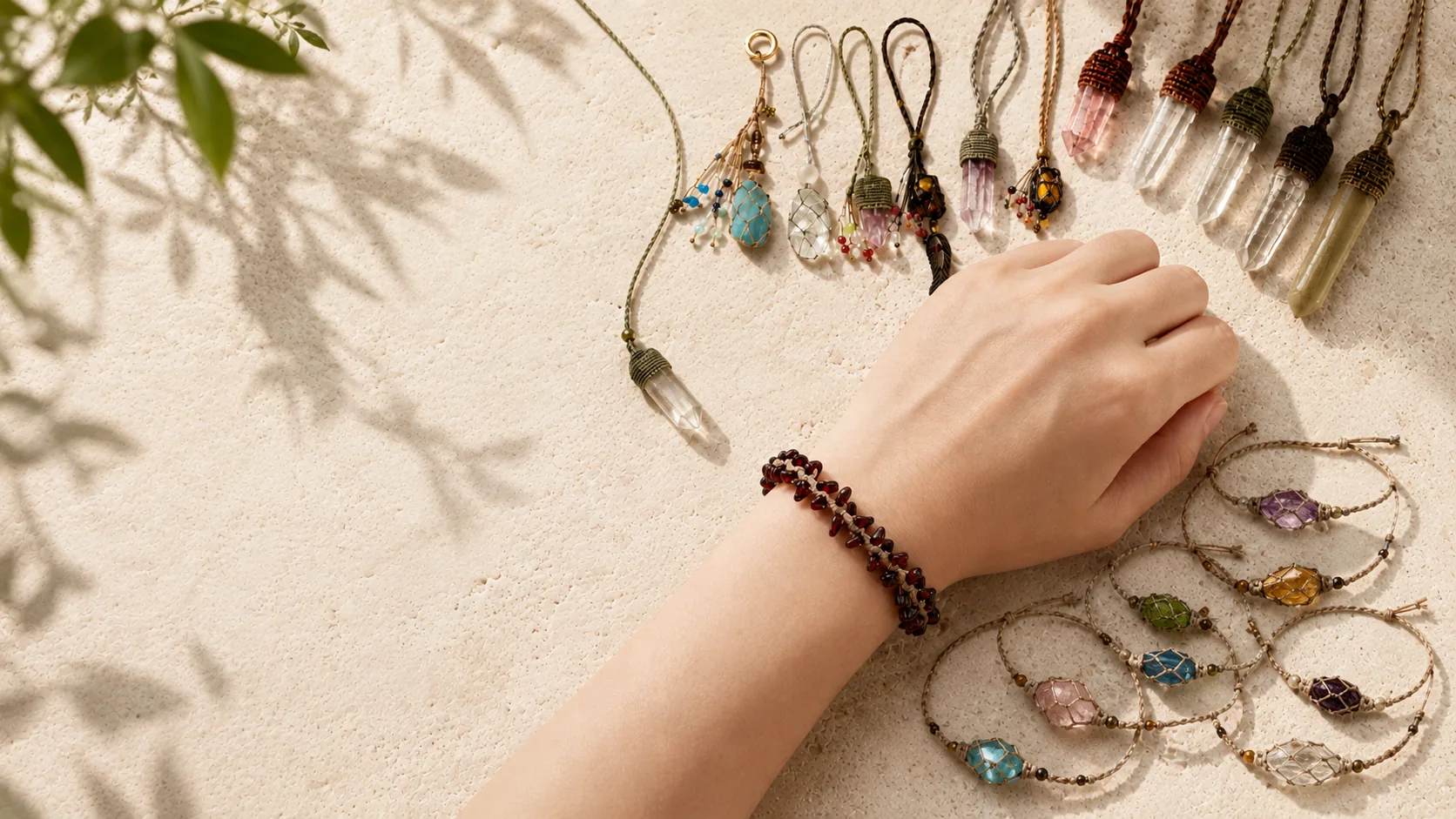
When your mind feels scattered, when your heart feels unsteady, when you are carrying too much noise from the outside world, touching a bracelet on your wrist can bring you back to the present moment.
Your fingers meet the cool, smooth texture of the stones. The deep red color reminds you of pomegranate seeds. And perhaps, quietly, something inside you says:
Slow down. You do not have to rush. You have your own rhythm. You can take root again.
When we made our garnet chip bracelet, the stones were not arranged in a perfect, mechanical line. The chips are different in size, shape, and shade. Some sit close together. Some leave a little space. No two are exactly the same.
As I worked on it, I kept thinking that this is also what life is like.
There is no single perfect pattern. No standard answer. No perfectly even path.
But small efforts, gathered one by one, can still become something full. A life can be made from many imperfect pieces, carefully held together.
When I feel tired or unsettled while working, I sometimes touch the stones on my own wrist. The cool surface passes under my fingers, and my mind slowly returns to where I am.
Not because the stone performs a miracle.
But because it helps me come back to this moment. And when a person returns to the present, it becomes easier to feel less afraid.
Why I Keep Returning to Garnet
Why do I keep wanting to make garnet pieces?
If I say it simply, it is because I understand the feeling of not having a firm ground under my feet.
There was a long period of my life when I felt deeply unsure of myself. I felt different from other people. I felt behind. I felt as if the road ahead had no clear shape, and every step was a little uncertain.
Later, handwork helped me stand a little more steadily.
Not all at once. Not in a shining, dramatic way. But slowly — one knot after another, one stone after another, one finished piece after another.
That is when I began to understand the kind of steadiness I see in a pomegranate.
You do not have to borrow someone else?s light. You do not have to become loud to be real. You can keep working with your own hands, filling your life slowly from the inside.
This is why our garnet pieces are not about selling instant luck.
They are about carrying a little warmth, a little weight, and a little reminder of inner fullness.
I hope that when you wear garnet, you can remember this:
You do not have to become someone bright and perfect in order to be worthy.
You can be like a pomegranate — plain on the outside, not perfectly shaped, moving at your own pace, but full within.
Root quietly. Gather slowly. Let your inner seeds become your own kind of light.